 Legal Narrative

Most people meet the law at a counter, not in a courtroom. It might be a landlord's agreement, a bank form, a police station corridor, a notice that arrives without explanation. By the time the law becomes visible to them, it is already doing something to their lives, and they are usually reading it for the first time under pressure.
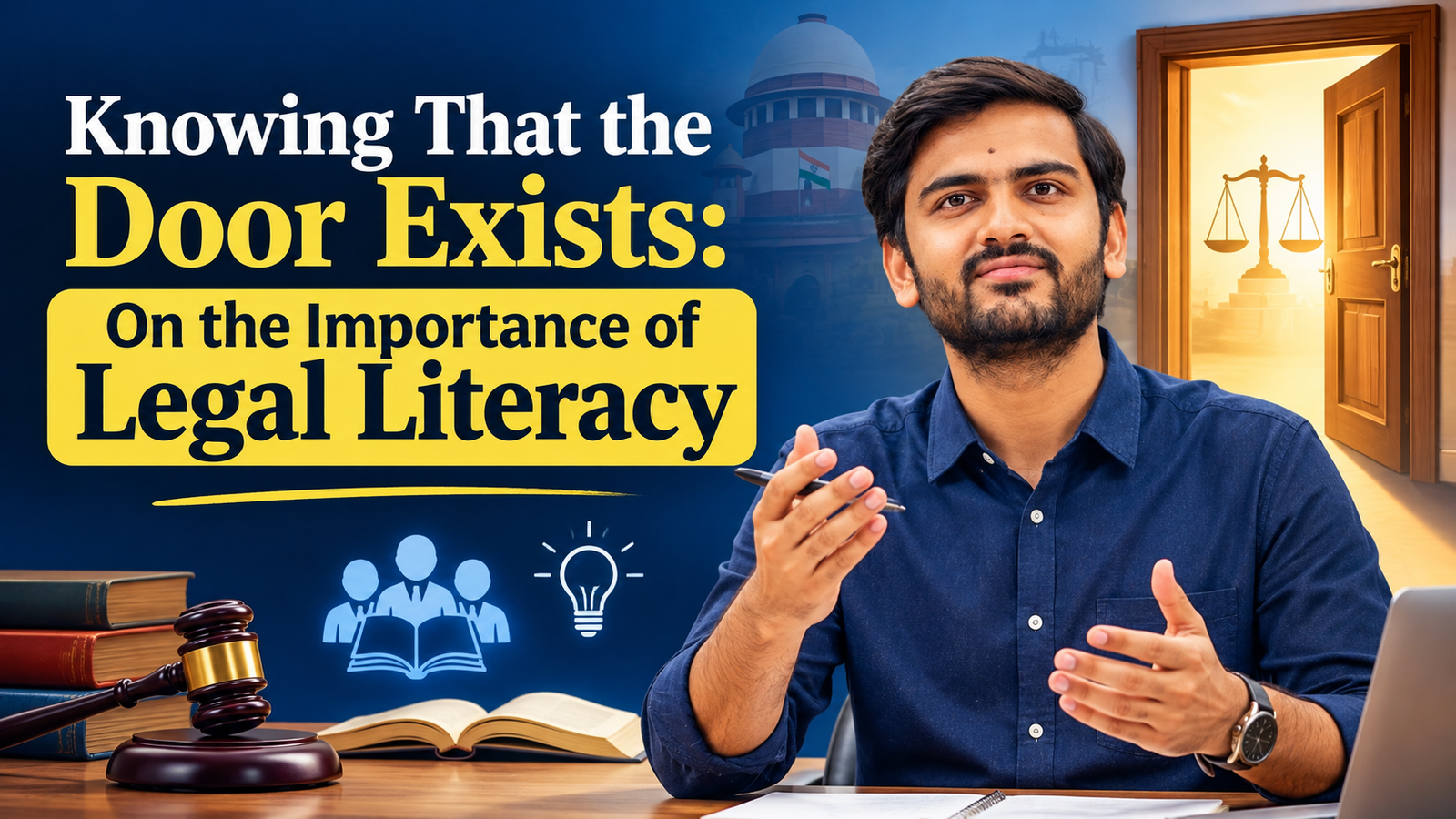
I think this is the real reason legal literacy matters. It is often described as knowing a lot of law, but that is not what an ordinary person needs. What helps is smaller and more practical. You need to recognise the moment when the law applies to you, to know that the other side is bound by a procedure, and to know where to go next. Nobody has to memorise sections for that. They only need to know the door exists.
We tend to forget how lopsided the arrangement is. The old maxim says ignorance of the law is no excuse, and the state applies it to everyone without exception. Yet the same state has done comparatively little to make sure people can actually know the law. A rule that presumes knowledge from every citizen carries a quiet duty to make that knowledge reachable.
The Supreme Court saw this long ago. In Khatri v. State of Bihar, the Court held that the right of a poor accused to free legal services would be hollow if it depended on that person asking for it. It reasoned that a magistrate must therefore inform the accused of the right, because it would make a mockery of legal aid to leave an ignorant and illiterate person to request it.[1] The point was a sharp one. A right can be recognised on paper and still be missing in a person's life, because they never learned it was theirs.
The constitutional text points in the same direction. Article 39A directs the State to ensure that the legal system promotes justice on the basis of equal opportunity and that opportunities for securing justice are not denied to any citizen because of economic or other disabilities.[2] Parliament gave this practical shape through the Legal Services Authorities Act, which entitles several categories of people to legal services, including women, children and persons in custody, once the authority is satisfied that a prima facie case exists.[3] But a service of this kind reaches only those who know to look for it. The scheme and the knowledge have to grow together.
Arrest is the clearest place to see this. Article 22(1) gives an arrested person the right to be informed of the grounds of arrest and the right to consult a lawyer of their choice.[4] The Bharatiya Nagarik Suraksha Sanhita carries these protections into statute. It requires that the grounds of arrest be communicated and that the person be told of the right to bail where the offence is bailable, and it gives the arrested person a right to meet an advocate during interrogation.[5] Years earlier, in D.K. Basu v. State of West Bengal, the Supreme Court had laid down requirements for every arrest, among them a memo of arrest attested by a witness and the informing of a relative or friend.[6] These are real safeguards. Still, think about the night itself. A family member who knows that an arrest memo must be prepared, and that someone must be told, stands in a very different position from one who simply waits outside and hopes. The safeguard exists in both cases. Only one family can use it.
The same applies to quieter encounters between citizen and state. Under the Right to Information Act, an applicant does not have to give any reason for seeking information, and the public authority must ordinarily respond within thirty days.[7] A provision like that changes how an ordinary person can speak to a government office. It asks a question and expects an answer. But a law of this kind is only as large as the number of people who have actually used it.
There is an obvious objection. If everyone starts reading statutes and quoting sections, are we not inviting half-informed confidence, the kind that does more damage than honest ignorance? I take the worry seriously, because bad legal advice from a confident acquaintance is a real problem. My answer is that literacy is not a substitute for a lawyer. It is what makes a lawyer useful. Compare it with health. Knowing a few symptoms does not make anyone a doctor, but it gets them to one sooner, helps them describe the problem honestly, and makes them harder to mislead. A person with basic legal literacy asks better questions, hesitates before signing what they have not read, and notices when advice does not add up.
Where should this learning happen? I doubt that classrooms full of memorised Articles are the answer. What stays with people is usually a situation they have rehearsed. What do you do when a notice arrives? What is a police officer required to tell you? Which office handles a rent dispute? Questions like these can be taught in schools, discussed in workplaces and explained in village meetings, but they only work in the language people speak at home. Legal information written in a register that only lawyers enjoy does not become knowledge for anyone else.
None of this makes the law simpler than it is. It does change who gets to stand on equal ground with it. A person who understands even the outline of their rights does not need to win every argument. They need only be taken seriously at the counter, in the corridor and before the magistrate, and that is often decided in the first few minutes.
Endnotes
[1] Khatri v. State of Bihar, (1981) 1 SCC 627, ¶ 6 (India).
[2] INDIA CONST. art. 39A.
[3] Legal Services Authorities Act, 1987, No. 39 of 1987, §§ 12, 13 (India).
[4] INDIA CONST. art. 22, cl. 1.
[5] Bharatiya Nagarik Suraksha Sanhita, 2023, No. 46 of 2023, §§ 38, 47 (India).
[6] D.K. Basu v. State of W.B., (1997) 1 SCC 416, ¶ 35 (India).
[7] Right to Information Act, 2005, No. 22 of 2005, §§ 6(2), 7(1) (India).





