 Legal Narrative

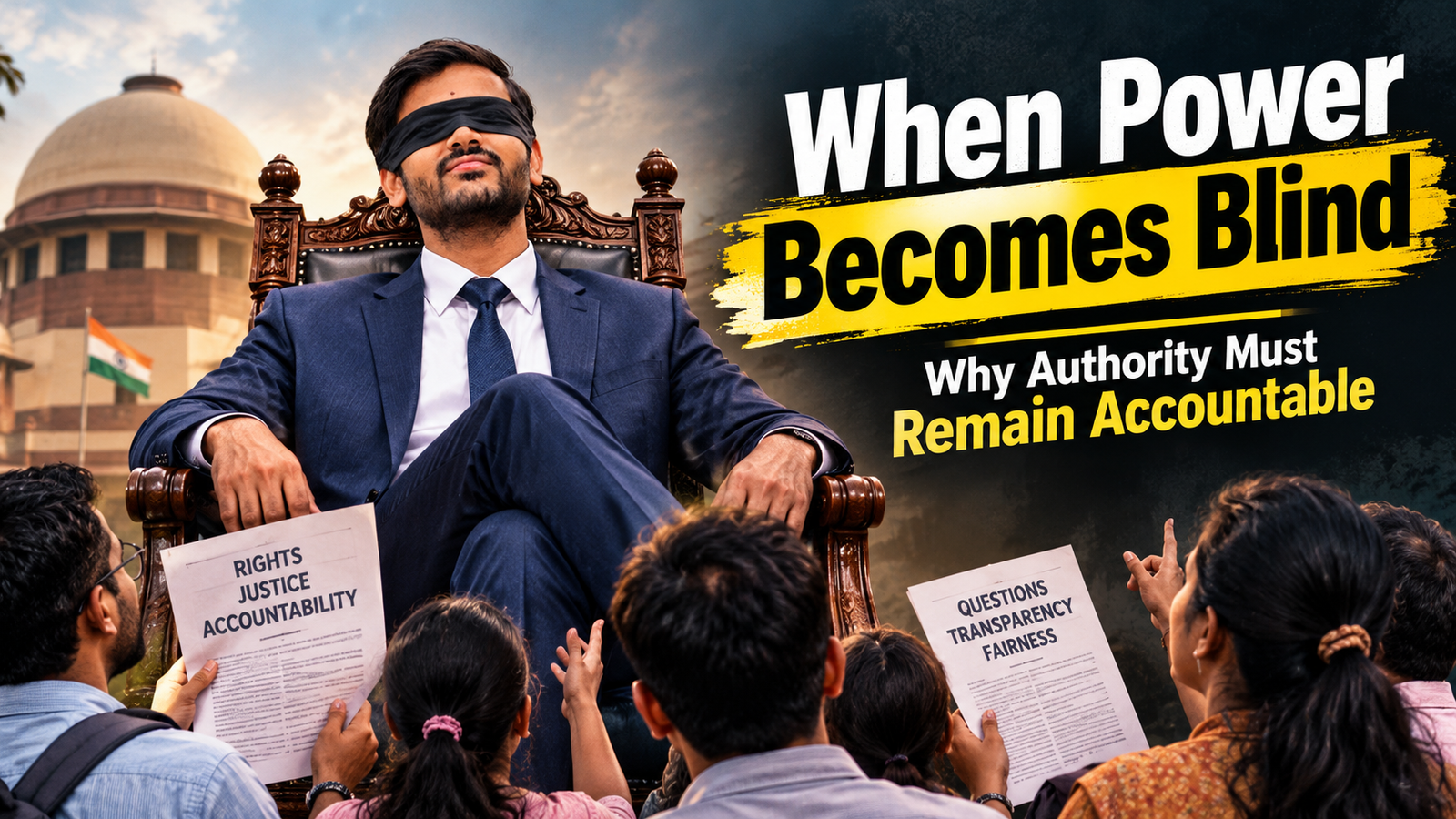
Power has a way of narrowing the vision of those who hold it. What begins as a means to serve a larger purpose often turns into an end in itself. The holder starts to see criticism as disloyalty, dissent as threat, and accountability as an unnecessary burden. This is not a new observation. It is a pattern repeated across centuries and continents, in palaces and ministries alike. When authority loses the capacity to examine itself, it stops serving the people and begins to serve its own preservation.
The Slow Distortion of Judgment
The English historian Lord Acton captured this danger with unusual clarity in a letter written in 1887. “Power tends to corrupt,” he wrote, “and absolute power corrupts absolutely.”[1] He was not speaking of some abstract moral failure. He was describing a practical reality: the more concentrated the authority, the less likely it is to be restrained by ordinary standards of judgment. Those who exercise power begin to believe that the rules apply differently to them. The office starts to sanctify the person who occupies it. That belief is the beginning of blindness.
This distortion rarely arrives overnight. It grows through small accommodations. A decision justified by urgency becomes a habit. A criticism dismissed once becomes easier to dismiss again. Over time, the circle of people whose opinions matter shrinks, and the language used to describe disagreement hardens. What once counted as healthy scrutiny is recast as obstruction or bad faith. The person in authority may still speak of public interest, yet the measure of that interest quietly shifts toward whatever protects the position itself.
Why Separation of Power Matters
This insight is older than Acton’s phrasing. In the middle of the eighteenth century, Montesquieu argued that liberty survives only when power is made to check power. In The Spirit of the Laws, he insisted that the legislative, executive, and judicial functions must not rest in the same hands, because the accumulation of those functions produces arbitrary rule.[2] The design of modern constitutional systems rests on that recognition. Separation is not an architectural preference. It is a response to the known tendency of authority to expand until it meets resistance.
The point is not that every officeholder is dishonest. Most begin with some sense of duty. The difficulty lies in the structure of the role. Power insulates. It filters information. It rewards loyalty more readily than candour. Without external points of friction, even well-intentioned people can lose the habit of testing their own assumptions. Institutions that force different centres of authority to confront one another create the conditions in which that testing can still occur.
The Indian Constitutional Response
In India, the Constitution absorbed this lesson without copying any single foreign model. It does not contain a rigid textual separation of powers, yet it builds multiple points of mutual restraint. Article 50 directs the State to take steps to separate the judiciary from the executive in the public services.[3] More significantly, the Supreme Court has held that the principle of separation of powers forms part of the basic structure of the Constitution and cannot be altered even by constitutional amendment. The decision in Kesavananda Bharati v. State of Kerala established that certain foundational features, including the rule of law and the independence of constitutional institutions, stand beyond the reach of ordinary political majorities.[4]
These arrangements exist because human beings who hold authority remain human beings. They are subject to the same incentives, fears, and ambitions that shape the rest of society. When the mechanisms of accountability weaken, those incentives tilt toward self-protection. Decisions that should be tested against evidence and principle are instead justified by the need to maintain control. Public purpose slowly yields to institutional survival. The language of necessity and emergency becomes a convenient shield. What looks like decisive leadership from the inside often appears, from the outside, as indifference to consequence.
Accountability Is Not Obstruction
Accountability is not the same as obstruction. A system that forces every action into endless procedural delay fails its purpose. But a system that treats scrutiny as hostility fails more dangerously. The first produces inefficiency. The second produces arrogance. Between these two failures lies the harder work of designing institutions that can act with firmness while remaining open to correction. Independent courts, free inquiry, competitive politics, and a public culture that does not confuse loyalty with silence all serve that end. None of them is perfect. All of them are necessary.
History shows what happens when these restraints erode. Authority that answers only to itself develops a selective blindness. It sees threats where there is disagreement and virtue where there is conformity. It confuses the interests of the powerful with the interests of the polity. The damage is rarely announced in dramatic declarations. It accumulates quietly, in the gradual acceptance that certain questions need not be asked and certain answers need not be given.
Keeping Authority Human
The remedy is not the abolition of authority. Societies require people who can decide, enforce, and lead. The remedy is the refusal to treat any concentration of power as self-justifying. Authority earns its legitimacy not by asserting it, but by remaining answerable to standards that exist independently of the people who currently hold office. That answerability must be practical, not ceremonial. It must include the possibility of reversal, of investigation, of political cost.
In the end, the demand for accountability rests on a simple recognition. Those who exercise power over others are not exempt from the ordinary requirements of judgment. When they become blind to that fact, the rest of us are left to live with the consequences. The task of every generation is to keep the mechanisms of restraint in working order, not because power is inherently evil, but because it is inherently human.
Endnotes
[1] John Emerich Edward Dalberg-Acton, letter to Mandell Creighton, 5 April 1887, in Historical Essays and Studies, ed. J. N. Figgis and R. V. Laurence (London: Macmillan, 1907).
[2] Charles de Secondat, Baron de Montesquieu, The Spirit of the Laws (1748).
[3] Constitution of India, Article 50.
[4] Kesavananda Bharati v. State of Kerala, (1973) 4 SCC 225; AIR 1973 SC 1461.





